



The trunk hive: a history of France
Deep within our forests and mountains, a fascinating return to our roots is taking shape. As modern beekeeping faces an unprecedented crisis, many enthusiasts and conservationists are turning to a long-forgotten practice: the log hive. By mimicking the natural nest of wild bees, this traditional habitat puts the colony’s wellbeing back at the centre of attention.
The trunk hive has no precise date of origin nor any recognised inventor. It emerged in the Middle Ages, when people began cutting hollow trees to bring them closer to their homes, thus moving from simple wild honey gathering to settled beekeeping. In France, it found its ideal home in the south, particularly in the Cévennes and the Massif Central. Crafted from rot-resistant chestnut trunks, lined up on rocky terraces and covered with a heavy slate slab as a roof, it has been a constant companion to generations of farmers.
The 20th century and the quest for ever-higher yields nearly put an end to this traditional craft. The arrival of modern hives with movable frames, such as the Dadant model, relegated the trunk hive to the status of a “museum piece”. The aim at the time was to be able to inspect the brood, increase the number of colonies and extract as much honey as possible. However, in the face of the current collapse in bee populations, the log hive is experiencing a spectacular resurgence in interest. Today, it is being revived not as a tool for production, but as a sanctuary for biodiversity, designed to shelter and strengthen the local bee population.

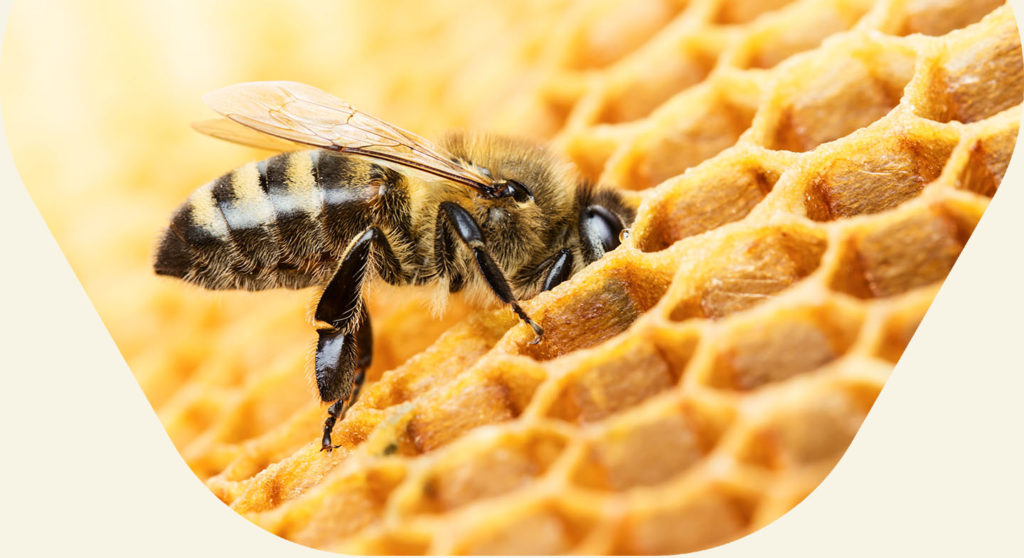
The principle behind the log hive is based on absolute respect for the biology of the insect. It consists of a vertical cavity hollowed out of a tree trunk, providing an ideal internal volume of around 40 to 50 litres. Inside, there are no embossed wax sheets or wooden frames: the bees build their wax combs freely from top to bottom, attaching them directly to the wood or to cross-braces fixed beneath the vaulted ceiling.
This structure provides unrivalled living conditions. Thanks to wooden walls 5 to 10 centimetres thick, the colony benefits from exceptional thermal insulation, staying cool during heatwaves and protected from frost in winter. The rough texture of the wood also encourages the bees to completely coat the interior with a layer of propolis, creating a natural antibacterial and antifungal barrier that protects the entire colony within the hive.
Adopting a trunk hive offers immense benefits for the health of the colonies. By minimising human intervention as much as possible, the stress on the bees is drastically reduced. The absence of regular opening of the hive and the absence of systematic chemical treatment allow the internal ecosystem to regulate itself and develop natural defences against parasites. It is the ideal habitat for anyone wishing to work towards safeguarding pollinators and encouraging natural swarming.
However, this choice involves accepting significant drawbacks. A trunk hive is an extremely heavy object, which is difficult, if not impossible, to move once installed. From a health perspective, the inability to remove the frames makes inspections difficult, which can raise issues during health checks (such as varroa mite infestation). Finally, one must forget about abundant honey harvests: the honey belongs first and foremost to the bees to help them survive the winter, and extraction – which is very occasional – is carried out simply by pressing the surplus combs.
As you will have gathered, the log hive is not merely a museum piece; it is still very much with us, and we must continue to preserve it despite the drawbacks of modern beekeeping…
As usual, share your photos with us: we’ll post them on our website from the social networks with the hashtag: #apifonda #apiinvert!
See you next month on your API blog with your faithful partner, Les Ruchers De Mathieu!
LES RUCHERS DE MATHIEU
Miellerie & Magasin d’Apiculture
Photos ©lesruchersdemathieu