



Do bees get cold in winter?
Winter has arrived across France and the first sub-zero temperatures are being felt! If we feel cold, do bees feel cold too? Although we are not the same, bees can feel the cold.
They are cold-blooded insects, which means they do not produce body heat like we do. Below 10°C, a bee that is isolated becomes immobile, cools down and can die very quickly. It is surrounded by all the other bees that they manage to warm up to survive. The group allows them to maintain a sufficient temperature.
How do they survive the winter? Honeybees use an impressive collective strategy known as winter clustering.
This cluster is formed by bees gathering in a compact ball around the queen. The bees in the centre vibrate their thoracic muscles to produce heat. The bees on the outside of the cluster act as insulation: they reflect the heat that escapes back towards the centre of the cluster. They regularly change position with those on the inside so that they do not freeze.
This allows the centre of the cluster to reach 30 to 35°C, regardless of the temperature outside the hive. The periphery of the cluster maintains a temperature of 8 to 12°C. To produce this heat, the bees use their muscles rather than the movement of their wings (they do not fly in winter).
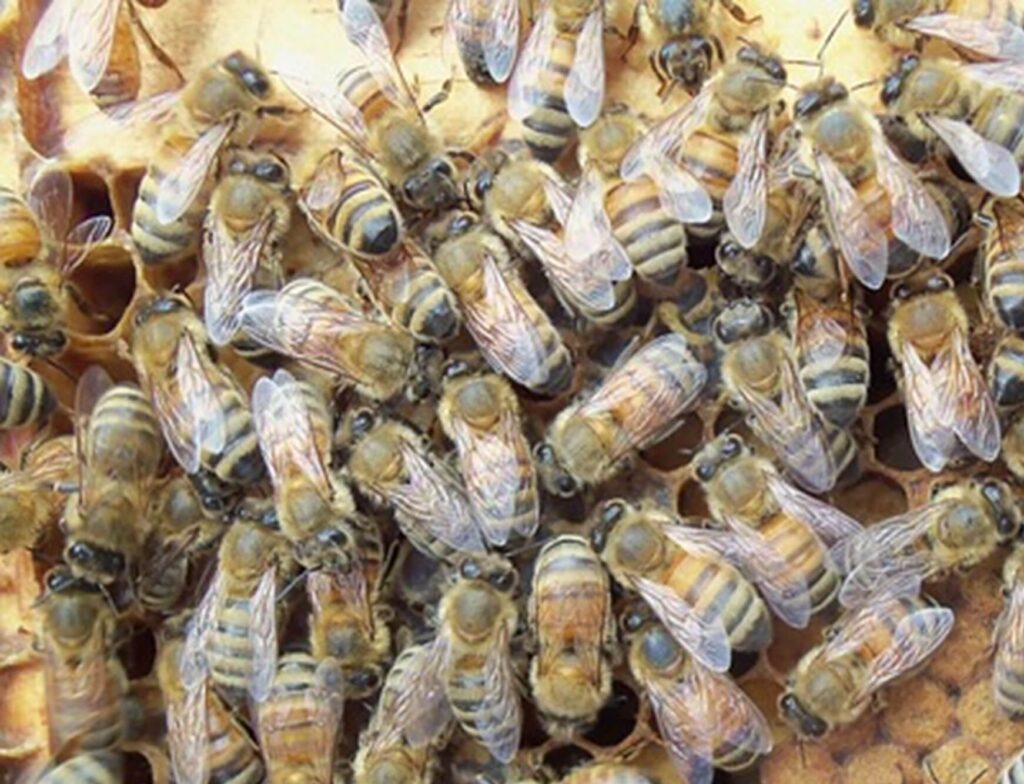
How many are there during winter? During winter, the colony will be much smaller than what we saw in spring. A healthy colony will go from 50,000 bees to only 10,000 in winter. The queen will also stop laying eggs, or at least lay very few. She will resume in February-March.
Contrary to what one might think, bees do not sleep all day during this winter break. They remain active. While activity is very intense in spring and summer, including cleaning, feeding the larvae, building combs, ventilating the hive, guarding the entrance, foraging, and collecting water and propolis, it changes completely in winter.
Movement within the hive is slow. Every effort is carefully considered: is it necessary or not yet? They conserve their energy. They hardly ever leave the hive anymore because below 12°C, they find it very difficult to fly.
As you can see, bees face the cold not individually but collectively, thanks to their remarkable social organisation!
Bees facing the seasons
As we know, bees play an essential role in pollination, yet their survival depends heavily on the changing seasons. Winter is a critical period for the colony, and climate change is disrupting their natural rhythm.
Cold weather:
Intense or prolonged cold weather can weaken bees by preventing them from accessing their food reserves. This situation could cause the death of part or even all of the colony.
Be vigilant about the insulation of your hive: install a bottom plate for ventilated floors, a layer of aluminium (such as Isoruch) on the frames and insulating foam in the roof (such as Apifoam).
Humidity:
Humidity is sometimes more dangerous than cold. It can cause condensation in the hive, which in turn can cause the bees to become cold. It can also encourage the growth of mould, which can make the colony sick. A word of advice: do not over-insulate the hive. If your floor is only 10 cm wide, leave it open. Only cover floors that are completely mesh (such as Nicot floors).
Lack of food:
A lack of honey in the hive could also cause the colony to be lost. There are many possible causes: a summer with few flowers, a colony that has consumed too many reserves, the beekeeper harvesting too much honey… Feed your bees if necessary with an Apifonda bread placed on the frames.

Marked by cold weather, lack of food and climate change, winter is a critical period for our bees. Understanding how it works is essential to supporting them during this time.
As usual, share your photos with us: we’ll post them on our website from the social networks with the hashtag: #apifonda #apiinvert!
See you next month on your API blog with your faithful partner, Les Ruchers De Mathieu!

LES RUCHERS DE MATHIEU
Miellerie & Magasin d’Apiculture
Photos ©lesruchersdemathieu