



Why and how to place the super?
After the quiet of winter, April brings a real surge of activity for beekeepers. From the end of March, the landscape changes and things suddenly pick up pace. This is the crucial moment when you need to anticipate the needs of your largest colonies. With the arrival of rapeseed flowers, the bees have a plentiful source of nectar for a few weeks. This spring honey flow is a golden opportunity: if there are fields near your apiary, it is not uncommon to harvest a full super per hive in record time. However, this abundance often triggers what is known as ‘swarming fever’. If space becomes scarce, the colony will naturally seek to split. It is therefore crucial to provide space at the right time.
But how can you be sure it’s time to add the super? Internal inspection is your best guide. A ready colony is one that has filled almost all its brood frames. By lifting the frame cover, you’ll see several compact brood frames, with neat circles of eggs surrounded by a ring of honey and pollen. An unmistakable sign: the appearance of fresh, white ‘wax bridges’ on top of the frames. This means the foragers are ready to work and are beginning to fill the available space.
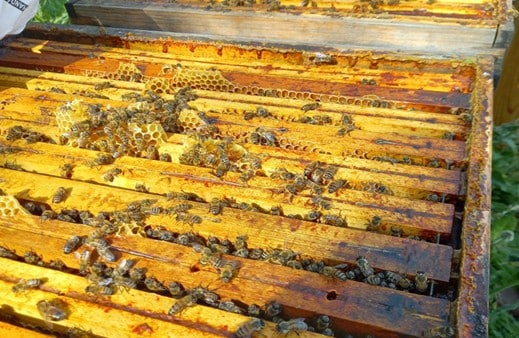
Before placing your super, a simple adjustment can help the queen work more efficiently. If some of the brood frames are not completely filled, reposition them between the brood and the honey stores at the sides. Be careful, however, never to separate the brood itself, as this could cause it to cool down: keep it tightly clustered in the centre. If you are using dividers, remove them and add built-up or foundation frames on either side of the brood block. This trick allows you to immediately expand the laying space and delay the urge to swarm, whilst preparing the workers to move up to the upper storey.
Finally, there is the question of the queen excluder, a subject that often divides beekeepers into two camps. This excluder, made of plastic or metal, prevents the queen from moving up to lay eggs in the super. Its advantage for harvesting is undeniable: it keeps the super frames clean and free of brood, which facilitates extraction and preserves the clarity of the wax. Nevertheless, it can act as a psychological barrier. Some colonies hesitate to cross it, preferring to store the nectar directly in the hive body. This behaviour can cause an ‘egg-laying blockage’: the queen has no more space for her eggs because the foragers fill everything up, which paradoxically encourages swarming during a strong honey flow. The choice is therefore yours, depending on your working method and the activity level of your bees.
The secret language of foraging bees
With the explosion of spring blossoms, one role becomes vital to the colony’s survival: that of the forager. But did you know that not all worker bees set off on their adventures in the same way?
Researchers have identified two very distinct profiles within a hive. On the one hand, we find the “explorers”, true adventurers with a curious nature. They take risks, travel miles and scout new territories in search of that rare gem: a rapeseed field or an orchard in bloom. On the other hand, there are “the followers”, who prefer to play the efficiency card. Rather than exhausting themselves searching at random, they wait inside the hive for directions from their sisters so they can head straight to the most promising spots.
This is where one of nature’s most fascinating phenomena comes into play: the bee dance. When a scout returns from a mission with a source of high-quality nectar, she does not simply unload her haul. Instead, she performs a precise choreography on the wax combs, surrounded by her sisters, to share her discovery. This communication takes the form of a circle (for very nearby sources) or a figure of eight (for more distant locations). This linguistic feat enables the ‘foragers’ to be sent to flowers sometimes as far as 3 kilometres from the hive, thereby optimising the harvest for the entire colony.

The precision of this dance is mathematical. Thanks to the work of the renowned researcher Karl von Frisch, we now know that bees use the sun as a reference point. The angle formed by the axis of their ‘figure of eight’ relative to the vertical indicates the direction to follow in relation to the sun’s position. As for the distance, this is conveyed by the intensity of the bee’s wiggling during its dance: the more vigorously and for longer it wiggles its abdomen, the further away the source is. This is how, through simple vibrations and geometric movements, a single scout bee can mobilise thousands of worker bees towards a new feast of pollen or nectar!
As usual, share your photos with us: we’ll post them on our website from the social networks with the hashtag: #apifonda #apiinvert!
See you next month on your API blog with your faithful partner, Les Ruchers De Mathieu!

LES RUCHERS DE MATHIEU
Miellerie & Magasin d’Apiculture
Photos ©lesruchersdemathieu