



How do bees evaluate queen performance?
The queen is the heart of the entire colony, but she is also constantly observed and judged by her daughters. Contrary to what one might think, it is not the worker bees who passively obey their queen’s commands, but rather the entire colony that assesses its mother’s health, strength and efficiency daily.
The first and most important way in which bees assess their queen is through their sense of smell, using very special chemical substances known as pheromones. By regularly licking and touching their queen, the worker bees pick up this unique scent and pass it on from bee to bee throughout the hive. This scent acts as an identity card: it tells every bee that the queen is indeed present, that she is in good health and that all is well. The younger and more vigorous the queen, the stronger and more soothing her scent, which maintains calm and unity within the hive.
But the bees do not rely solely on her scent; they also closely observe her egg-laying. Every day, they inspect the frames to see how the queen lays her eggs. A good queen can be recognised by her brood, which is compact and uniform, with very few empty cells: nearly 2,000 new bees in the spring! This proves to the worker bees that she is capable of renewing the population and securing the colony’s future with young bees that are strong and full of energy for work.
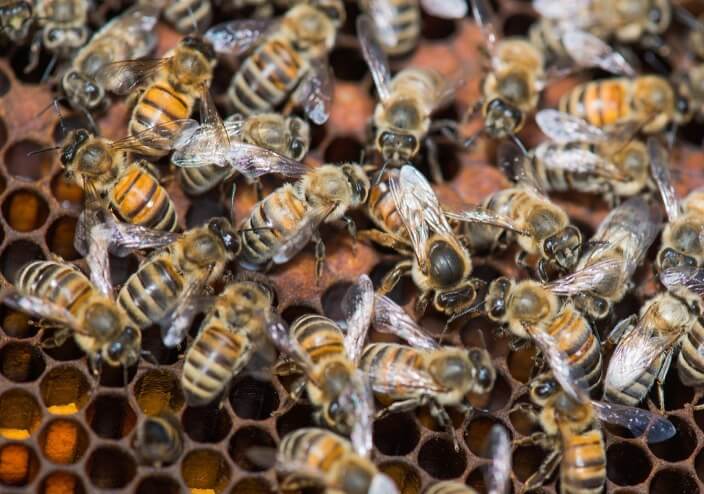
Conversely, if the queen begins to tire, grow old or fall ill, the warning signs soon become apparent. If the brood becomes sparse or full of gaps, or if the queen starts laying eggs haphazardly and producing drones, the bees notice this immediately. The queen’s scent weakens and her performance deteriorates, sowing doubt and concern amongst the worker bees.
Faced with a queen who is no longer fulfilling her role properly, the colony then takes radical measures to ensure its survival. The bees may decide to remove her (kill her) in order to rear a new one – a natural process – or prepare emergency queen cells to replace her as quickly as possible. For us beekeepers, closely observing the condition of the brood and whether the bees on the frames are calm or agitated is the best way to gauge what the colony thinks of its queen, long before we manage to spot her with our own eyes.
In autumn and winter, rest assured, egg-laying is very low or even non-existent. Don’t panic – this is normal. It is in spring that you will be able to check whether the brood is compact and thus judge the quality of the queen.
The expert’s eye
How to install the bee fondant without cooling the hive
During the winter months, every time a hive is opened, there is a risk that the internal temperature will drop sharply, weakening the cluster. Here is a step-by-step guide to adding bee fondant quickly and cleanly, whilst retaining all the heat of the brood.
Preparing your equipment in advance: Prepare an insulated aluminium frame cover (such as an ‘Isoruche’) beforehand. Cut a hole of about 5 cm in one of the sides, which will serve as direct access to the feed.
The procedure at the apiary:
- Warn the bees: Blow a few puffs of smoke through the hive entrance to encourage them to come down and prevent panic.
- Remove the frame cover: Take off the roof, then gently lift the original frame cover using a frame lifter whilst blowing a further wisp of smoke.
- Position the insulator according to the cluster: Place the Isoruche directly onto the frames. Observe the position of the bee cluster: if the cluster is towards the front, orient the hole in the insulator towards the entrance. If the cluster has shifted towards the back of the hive, reverse the position and place the hole towards the rear (particularly for Nicot double-compartment feeders; otherwise, you can make the hole in the centre of the Isoruche).
- Install the fondant: Using your frame lifter, cut and peel off the plastic film from your fondant bag. Turn it upside down and press the opening directly over the hole in the Isoruche. The bees will be able to access it immediately whilst remaining well protected by the thermal barrier.
- Close the hive: Position your feeder upside down on top to compensate for the extra thickness created by the bag. Add your top insulation, then close the hive.
Check the hive every month until next March to ensure the bees always have fondant available in the bag.
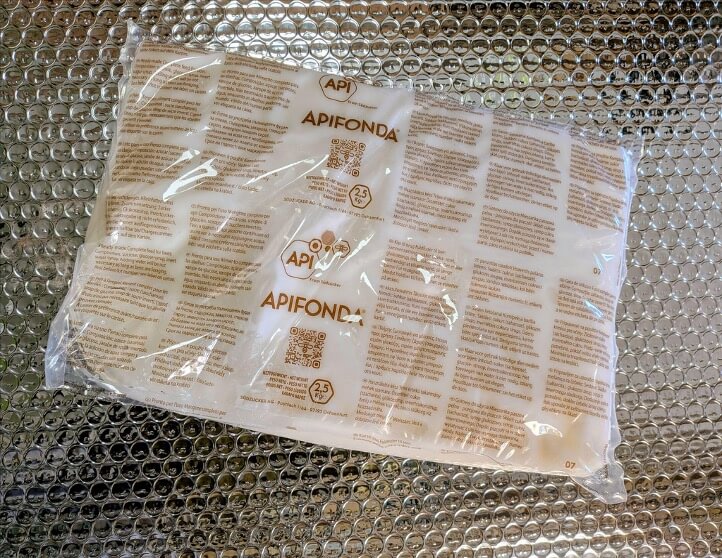
As usual, share your photos with us: we will publish them on our website from social networks with the hashtag: #apifonda #apiinvert!
See you next month on your API blog with your loyal partner, Les Ruchers De Mathieu!

LES RUCHERS DE MATHIEU
Miellerie & Magasin d’Apiculture
Photos ©lesruchersdemathieu