



Mathieu DOMECQ
Editor-in-chief of the API of the Month and Blog
In May, beekeeping enters its most spectacular phase. As nature displays its full vigour, work at the apiary demands constant vigilance, with favourable weather conditions in most regions.
This month, we will focus in particular on the spring honey harvest: a crucial moment when we must act quickly to extract the rapeseed honey before it crystallises in the combs. We will discuss the technique of harvesting by brushing the frames, a gentle method.
Finally, we will look at how to strategically place additional supers. These tasks, combining perfect timing and technical precision, are the cornerstones for transforming your bees’ energy into an exceptional harvest.

Tasks of the month
May is a bustling time for beekeepers. The apiary is now in full swing. From acacia groves to clover fields, nectar sources are at their peak.
The colony reaches its peak population, creating a veritable swarm of workers ready to harvest the nectar. This is the moment of truth when space management becomes crucial to turning this power into a bountiful harvest. Here are the main tasks to be carried out at the apiary this month:
Monitor young swarms: If you have just acquired a new swarm on frames, be particularly vigilant. Unlike an established colony, a young swarm has no safety reserves. If the weather turns changeable or rainy for several days, keep a very close eye on their food supply and do not hesitate to provide them with a supplement of APIINVERT® syrup.
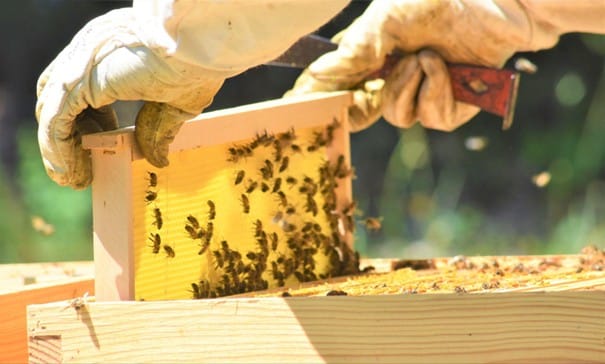
Add new supers: Nature is bountiful in May. If you notice that the bees are starting to cover the tops of the frames with fresh wax or that the current super is three-quarters full, do not hesitate to add a new super. A lack of space to store nectar is the first sign that prompts a colony to swarm.
Splitting the colony: If you notice that egg-laying has stopped due to an excess of brood frames (often more than 7 or 8 frames in a 10-frame Dadant hive), it is time to split the colony. By removing two or three brood and feed frames to create a new colony, you reduce the pressure and thus control swarming instinct whilst expanding your stock.
Renewing the wax: Spring is the ideal time for hive hygiene. Take advantage of the strong wax production to introduce new embossed frames and replace the old black frames. New wax limits the spread of disease and provides larger cells for the hatching of vigorous young bees.
The honey flowers of the month
acacia (nectar), dandelion (nectar and pollen), photinia (nectar), hawthorn (nectar and pollen)…